
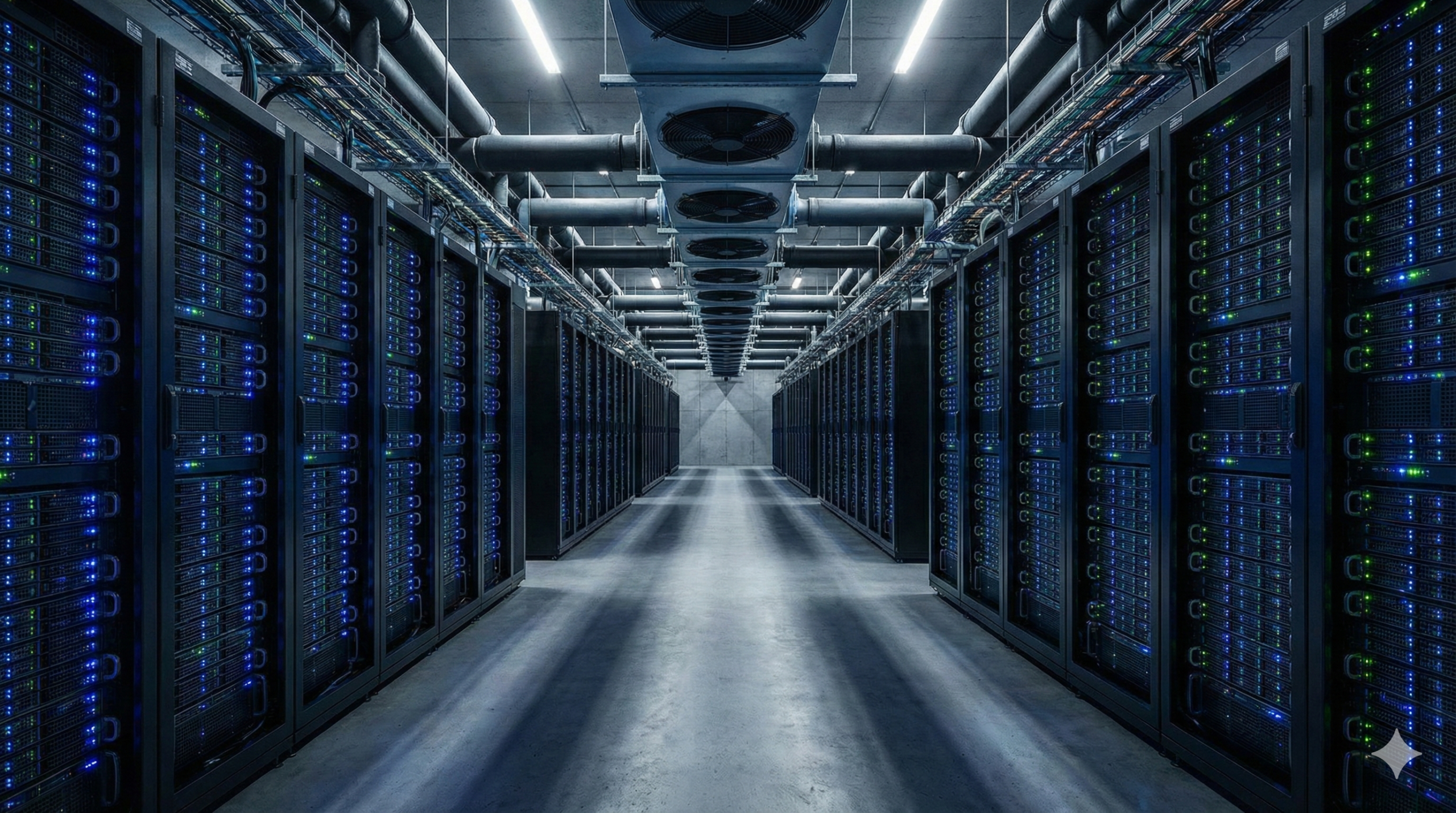
The past few years have seen the world’s leading technology giants invest billions in AI infrastructure. New data centers. Specialized chips. Cloud expansion on a massive scale. Long-term power contracts.
It can appear overkill from the outside. However, this spending is not discretionary. For firms competing in AI, infrastructure is the differentiator.
Here’s why the race is so intense.
AI Is Inherently Infrastructure-Intensive
Conventional software scales cheaply. After development, it mainly runs on existing servers.
AI doesn’t work that way.
Training large models needs:
- Vast computational power
- Specialized hardware
- High-speed networking
- Reliable cooling and energy
Running such models at scale incurs an additional cost. Inference needs to happen quickly, be available worldwide, and be sufficiently cheap to support millions of users.
If the company does not own or control this infrastructure, then it will have to rely on someone who does.
Compute Is the New Bottleneck
The increasing demand for
What used to be the limiting factor is talent. Now it’s compute.
The world’s best researchers cannot develop competitive models without access to massive computing resources. Even the best-funded teams will reach a point where they cannot compete if they are dependent solely on third-party providers.
Owning infrastructure means:
- Faster experimentation
- More training runs
- Bigger and better models
- Reduce costs per unit of compute over the long term
This is why firms are contracting for supply years in advance.
Custom Chips Mean Lower Costs and More Control
General-purpose GPUs are very powerful, but they are also very expensive and in short supply.
This is why the big tech firms are developing their own AI chips. Custom hardware:
- Reduces costs at scale
- Enhances performance for particular workloads
- Reduces reliance on third-party vendors
- Ensures supply chain stability
After a certain volume is reached, it becomes less expensive for the company to manufacture its own chips rather than purchasing them off the shelf.
Infrastructure is no longer a servers-only game. It’s about silicon.
AI Products Require Always-On Capability
AI products require an
AI products are not batch processes. They are always running.
Chat systems, copilots, recommendation engines, and AI agents all need:
- Low latency
- High availability
- Global coverage
- Predictable performance
This implies over-investing in capacity and locating infrastructure near users.
Cloud regions that are optimized for AI applications are now as important as app stores were.
Vertical Integration Is a Competitive Moat
Those companies that have control over the entire stack have an advantage.
That stack consists of:
- Data
- Models
* - Infrastructure
- Distribution
When the infrastructure is internal, the teams are able to tightly optimize all layers. The models are trained on the hardware. The software is optimized for performance. The costs are easier to manage.
This establishes a barrier that is difficult for new entrants to overcome.
The Economics Favor Scale
The Economics Favor Scale
The value of AI rewards scales more than almost any other technology that has ever been developed.
Big businesses can:
- Spread infrastructure costs over many products
- Reuse models and systems internally
- Better energy and hardware deals negotiated
- Absorb upfront costs others can’t
After the infrastructure has been developed, the marginal costs become lower. This increases the difference between the cost of incumbents and the cost of new entrants.
Power and Energy Are Now Strategic Assets
The power consumption of AI infrastructure is quite high.
As a consequence, technology firms are:
- Entering into long-term energy contracts
- Investing in renewable energy sources
- Establishing data centers close to sources of cheap energy
The reliability of energy is directly linked to the reliability of AI. This is no longer an operations issue. It is a strategic issue that needs to be addressed at the board level.
Defensive and Offensive Reasons
There are two reasons for the spending.
**Def
If the infrastructure is in the hands of your competitors, then you are at their mercy as far as price, availability, and performance are concerned
**Off
Owning infrastructure enables you to roll out new AI products quickly, affordably, and worldwide.
Both push companies towards the same conclusion: invest now or fall behind.
What This Means for Startups and Developers
Not all people need to create data centers. But it does mean: * AI will increasingly run on platforms owned by a few large players * Infrastructure costs will determine what products are feasible * Efficiency and specialization will be more important in smaller teams Startups that succeed will design around these constraints rather than fighting them. — ## The Bottom Line The enormous investment in AI infrastructure is not hype or overkill. It is the cost of doing business in an AI-first world. For leading technology companies, infrastructure is no longer a back-end issue. It is the basis for future products, profits, and power. This is why the spending is taking place at this time. This is why it is only accelerating.